
Article Summary
A dielectric rubber filler is a particulate additive blended into uncured rubber to influence electrical, mechanical, thermal, processing, or cost characteristics. The phrase can also be confused with dielectric grease, which is applied to cured parts. This guide focuses on internal filler selection, the data to request from a supplier, cost-per-volume comparisons, and qualification before a production change.
| Filler or product | What it does | Where it is used | Key property affected |
|---|---|---|---|
| Precipitated and fumed silica | Reinforces the matrix while the compound stays resistive | Silicone gaskets, boots, keypads, cable accessories | Tensile strength, volume resistivity |
| Alumina trihydrate (ATH) | Suppresses surface tracking and erosion under electrical stress | Outdoor high-voltage silicone insulators and sheds | Tracking and erosion resistance |
| Barium titanate | Raises relative permittivity sharply | Field-grading layers, dielectric elastomer transducers | Dielectric constant |
| Boron nitride and alumina | Moves heat out while current stays blocked | Power electronics pads, EV battery and busbar gaskets | Thermal conductivity |
| Mica and calcined clay | Adds a low-cost insulating extender with platy structure | Wire and cable jackets, sheet goods | Cost per volume, resistivity |
| Dielectric silicone grease, separate maintenance product | Applied to cured rubber parts as a moisture and contamination barrier | Spark plug boots, connectors, and O-rings | Surface protection and serviceability |
What a Dielectric Rubber Filler Is
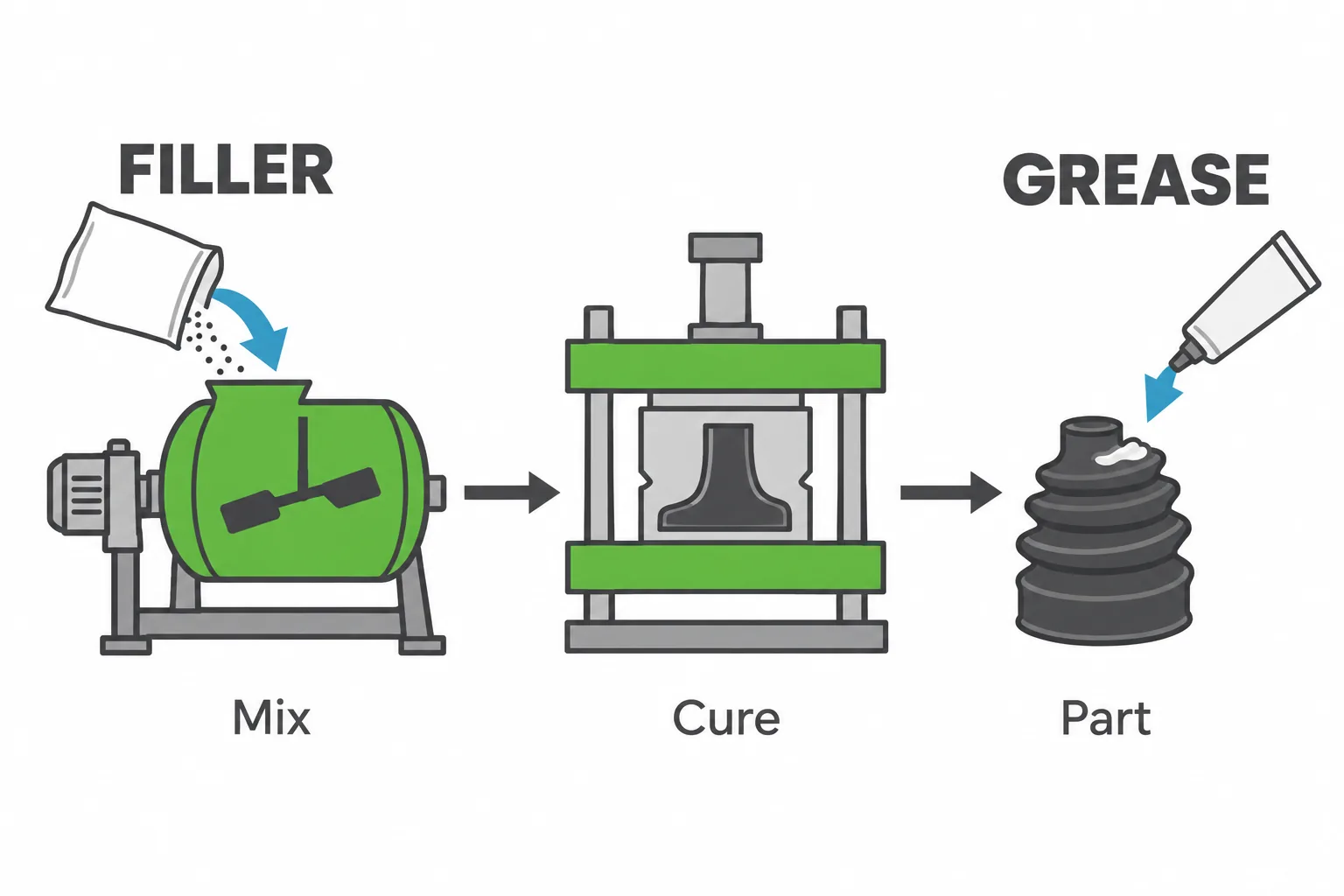
Every filler in a rubber compound can affect more than one property. A dielectric rubber filler is selected according to the electrical requirement, such as high resistivity, high dielectric strength, controlled permittivity, or low dielectric loss, while reinforcement, thermal performance, processing, and cost remain part of the trade-off. Permittivity describes how a material stores electrical energy; it does not by itself prove that a compound will provide adequate insulation.
The four measurements below should be requested for the cured compound, with the test frequency, thickness, cure, temperature, humidity, and conditioning stated.
Raw-powder data cannot replace formulation-specific testing.
| Property | What it tells you | Common unit | Test method to request |
|---|---|---|---|
| Dielectric strength | Voltage per unit thickness the part survives before breakdown | kV/mm or volts/mil | ASTM D149 |
| Relative permittivity (dielectric constant) | How much electrical energy the material stores | Dimensionless | ASTM D150 |
| Dissipation factor | Energy lost as heat under an alternating field | Dimensionless | ASTM D150 |
| Volume and surface resistivity | How strongly the material blocks current through and across it | ohm-cm and ohms | ASTM D257 |
A filler rarely optimizes all four properties at once. Higher permittivity may come with higher dielectric loss, stiffness, or density, while higher loading can increase viscosity and complicate dispersion. Treat the table as a decision framework rather than a ranking. The filler classes in this guide are discussed for formulation education; CFI’s featured product is Austin Black 325, and the comparison does not imply that CFI supplies every material listed.
Dielectric Rubber Filler vs. Dielectric Grease: Which Product Do You Need?
| Aspect | Compounded internal filler | Dielectric grease or paste |
|---|---|---|
| Form | Dry powder | Non-curing silicone paste thickened with fumed silica |
| Point of use | Added at the internal mixer or mill | Applied by hand to cured parts |
| Function | Permanent change to the vulcanizate | Removable moisture and contamination barrier |
| Who buys it | Compounders and part manufacturers | Field technicians, assemblers, service shops |
| Unit of sale | Bags, super sacks, bulk | Tubes, cartridges, pails |
If you formulate rubber, the remaining sections cover filler selection and qualification. Dielectric grease is a separate maintenance-product topic rather than an Austin Black 325 product; use the comparison above to avoid treating grease as an internal filler.
Filler Classes by Electrical Requirement
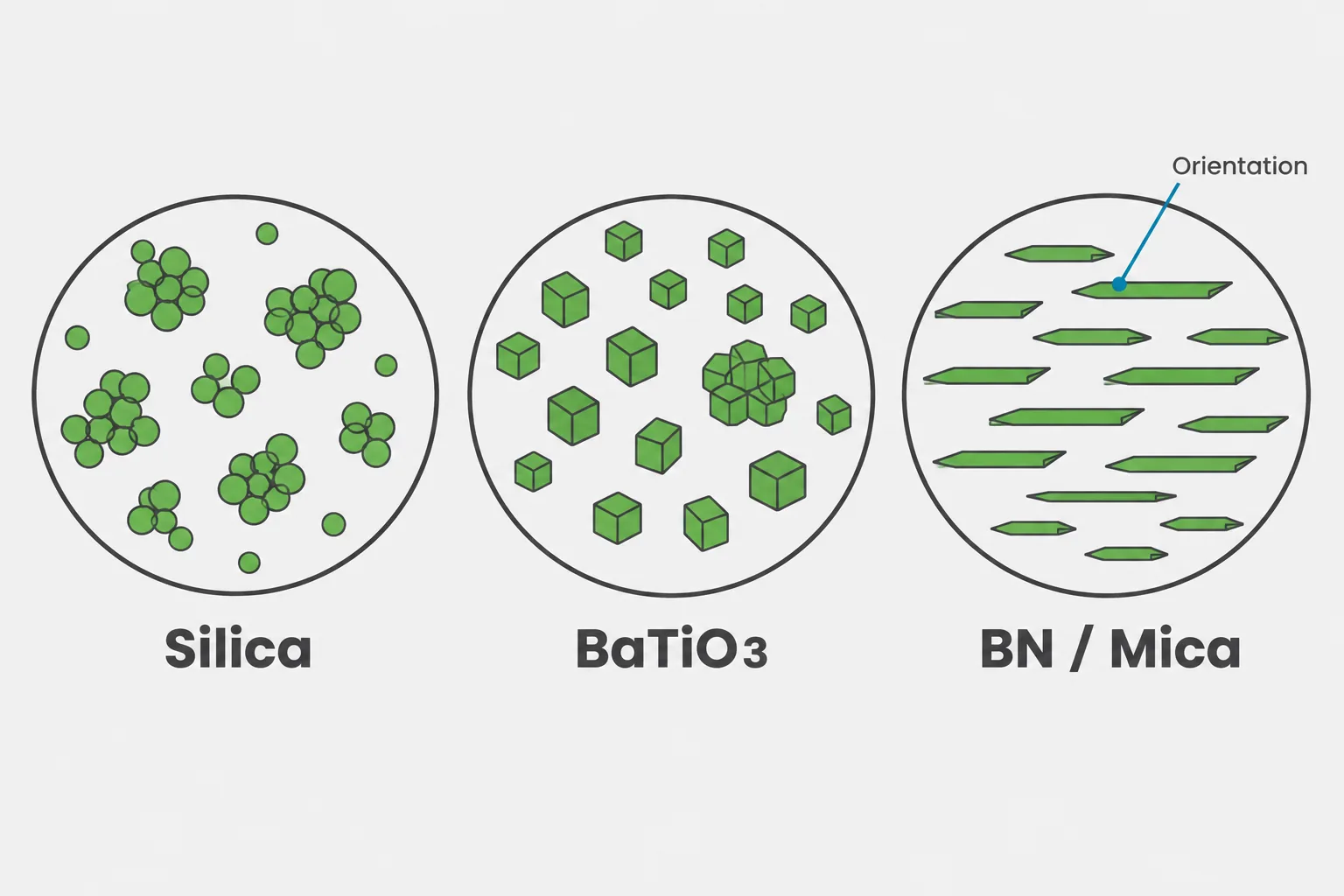
Published silicone-rubber work shows that filler type, shape, particle size, surface treatment, and loading can change both electrical and mechanical results. Use literature as trial context, not as a specification for a different elastomer, cure system, or production process. Read the study on filler effects in methyl vinyl silicone rubber for an example of how those variables were evaluated.
| Filler | Chemistry | Role in the compound | Effect on permittivity | Effect on thermal conductivity | Main drawback |
|---|---|---|---|---|---|
| Fumed silica | SiO2 | Reinforcement without a conductive network | Slight rise | Slight rise | High viscosity, moisture pickup |
| Precipitated silica | SiO2 | Lower-cost reinforcement | Slight rise | Slight rise | Needs silane treatment for low loss |
| Alumina trihydrate | Al(OH)3 | Tracking and erosion resistance, flame retardance | Moderate rise | Moderate rise | High loadings stiffen the compound |
| Barium titanate | BaTiO3 | High permittivity and field grading | Large rise | Small rise | Density, cost, agglomeration risk |
| Alumina | Al2O3 | Thermal path with electrical isolation | Moderate rise | Large rise | Abrasive to tooling |
| Boron nitride | BN | Thermal path with very low loss | Small rise | Large rise | Price, platelet orientation effects |
| Mica | Aluminosilicate | Insulating platy extender | Small rise | Small rise | Anisotropic properties |
| Calcined clay | Aluminosilicate | Economical insulating extender | Small rise | Small rise | Limited reinforcement |
Silicone is a common base for electrical-insulation compounds, but filler loading, cure system, moisture, and surface treatment still determine the measured result. CFI serves silicone manufacturers and describes Austin Black 325 as a filler used in silicone formulations; the other classes in this table remain general formulation options.
Silica as a Reinforcement Filler That Stays Resistive
Silicone gum has limited tensile strength without reinforcement. Fumed silica can build strength through surface interaction with the polymer chains, but the electrical result still depends on the complete formulation. Surface treatment may help control filler–polymer interactions and dielectric loss in alternating-field service; confirm the effect on the cured compound. High-surface-area silica can raise viscosity and hold moisture. Residual moisture can reduce measured breakdown performance and increase test variability, so filler drying, dispersion, cure, and post-cure conditions should be controlled.
Alumina Trihydrate for Tracking and Erosion Resistance
ATH is a hydrated mineral. Heat drives off its bound water, and that decomposition absorbs energy from the surface where an arc or dry-band discharge is active. Lower surface temperature means less thermal decomposition of the polymer, which means fewer conductive carbon tracks form across the insulator face. Flame retardance and smoke suppression come along as secondary benefits.
Outdoor high-voltage silicone compounds carry ATH at loadings high enough to dominate compound rheology, which changes mixing, extrusion, and cure behavior noticeably. Performance is judged through inclined-plane tracking and erosion methods such as IEC 60587, along with comparative tracking index work. Ask for those results on the finished compound, since a filler that performs well in one silicone base can behave differently in another.
Barium Titanate When High Permittivity Is the Goal
Some designs need controlled permittivity rather than maximum insulation. Barium titanate is one option when a formulation requires higher permittivity. A published high-permittivity silicone-composite study reported an increase from about 2.6 to roughly 5 under its specific formulation and test conditions; those values should not be treated as universal specifications.
The trade-offs can include higher density, higher cost, greater stiffness, and agglomeration risk. Evaluate dispersion, dissipation factor, mechanical properties, and breakdown together rather than selecting the filler from permittivity alone.
Dielectric Strength, Permittivity, and Resistivity in Rubber
There is no single dielectric-strength value for “rubber.” Published results vary with the elastomer, formulation, sample thickness, electrode geometry, test frequency, temperature, humidity, conditioning, and voltage-rise rate. Thin samples may report a higher strength per unit thickness than thicker samples of the same compound, so a value without its method and test conditions is not enough for design work.
One kV/mm equals about 25.4 volts per mil. A value of 20 kV/mm and a value of 508 volts/mil therefore describe the same electric-field strength, provided the test conditions are comparable.
| Elastomer | Where it shows up electrically | What drives its dielectric result | Watch item |
|---|---|---|---|
| Silicone | HV insulators, boots, keypads, thermal pads | Silica type, ATH level, post-cure | Moisture retention before cure |
| EPDM | Cable accessories, weather seals, roofing sheet | Non-polar backbone, filler purity | Ionic contamination from fillers |
| Natural rubber | Insulating gloves, matting, sheet goods | Low polarity, clean compounding | Ozone and thermal aging |
| Neoprene | Jackets, mats, protective covers | Chlorine content raises polarity | Higher loss than EPDM |
| Nitrile | Fuel-resistant seals near electrical zones | Polar nitrile groups | Elevated dissipation factor |
| Butyl | Splicing tapes, mastics, sealing layers | Very low gas and moisture permeability | Slow cure, tack management |
Ask suppliers for D149, D150, and D257 data on the specific cured compound, with the test frequency, specimen thickness, cure or post-cure, temperature, humidity, and conditioning recorded. For outdoor insulation, add the applicable tracking, erosion, arc-resistance, or comparative-tracking test rather than treating bulk breakdown strength as the complete specification.
Carbon Fillers in Rubber: Conductive or Not?
Does carbon conduct electricity? In bulk graphitic form, yes, and that fact drives a lot of confusion in rubber work. Carbon conductivity inside a compound does not scale smoothly with loading. It follows a percolation curve. Below the percolation threshold, the particles stay isolated in the polymer, and the compound remains resistive. Once enough particles touch to form continuous pathways, resistivity drops by orders of magnitude over a narrow loading window.
Where that threshold sits depends on filler structure, particle size, surface chemistry, loading, and dispersion. CFI’s explainer on whether carbon is conductive covers the basic mechanism; supplier data on the actual grade and cured formulation should control the decision.
| Filler role | Resistivity behavior | Suitability for insulation compounds |
|---|---|---|
| High-structure conductive black | Low resistivity above percolation | Not suitable in the dielectric layer |
| Standard reinforcing black at moderate loading | Mid-range, sensitive to loading changes | Possible with testing and tight loading control |
| Low-structure or organic carbon filler | Higher resistivity, gradual response | Often workable, confirm on the cured compound |
| Mineral or ceramic filler | High resistivity | Suitable, chosen for the electrical result |
The practical rule for insulation work: keep carbon loading and structure well below percolation, or confine carbon-filled stock to outer non-electrical layers such as covers and jackets.
Volume Resistivity as the First Screen
Breakdown testing takes time and destroys samples. Volume resistivity screening catches conductivity problems earlier and far more cheaply, so it belongs at the front of any trial matrix. Compounds fall into recognizable bands: conductive stock intended to carry or drain current, static dissipative stock for controlled discharge, and insulating stock for dielectric duty. A candidate that lands in the wrong band never needs a breakdown test.
Measure on the actual cured compound. Raw filler resistivity says little about the network that forms inside a mixed and vulcanized part. CFI’s reference on the resistivity of carbon explains why the two values can diverge.
Can Austin Black 325 Be Used as a Dielectric Rubber Filler?
Austin Black 325 is a finely divided, low-specific-gravity filler produced from low-volatile bituminous coal. CFI’s current Austin Black 325 technical data sheet lists a typical specific gravity of 1.31 ± 0.03. Lower density may support lower part weight or cost per filled volume in suitable formulations, but comparator values should come from the technical data for each competing filler.
CFI’s public product materials discuss insulating properties, but Austin Black 325 is not presented in the current TDS as a specialty dielectric grade with published D149, D150, or D257 specifications. Treat electrical suitability as formulation-dependent and confirm it through controlled lab trials. CFI lists formula testing, lab samples, toll grinding for black minerals, and packaging support as available services.
For powder-handling requirements, use the current Austin Black 325 SDS. It identifies combustible dust and repeated-inhalation precautions, so the product should be handled according to the SDS and applicable workplace requirements. CFI says it has manufactured filler materials since 1987, operates in West Virginia and Virginia, and serves customers in more than 30 countries.
Carbon Black Comparison for Rubber Formulators
Carbon black remains an important reinforcement option for modulus, abrasion resistance, and UV protection. A grade change can also change the electrical result because filler structure and surface area affect the conductive network. Some formulators may evaluate a blend of reinforcing black and a lower-density organic filler, but the mechanical, electrical, cure, and processing effects must be measured in the target compound.
Choose a Filler by Electrical Requirement
Electrical margin is not free, so match the filler class to the actual requirement rather than to the most impressive datasheet. Designs with generous headroom can trade a little margin for cost and weight. Designs running near their limit cannot. For a grade-by-grade shortlist built around real test targets, see how to pick electrically insulating fillers for your compound.
Related readingHow to Increase Rubber Abrasion Resistance: Testing GuideRead the guide →| Application | Primary electrical requirement | Filler class to evaluate | Secondary consideration |
|---|---|---|---|
| Outdoor HV composite insulators | Tracking and erosion resistance | ATH with treated silica | Hydrophobicity recovery, UV exposure |
| Medium-voltage cable accessories | Controlled permittivity for field grading | Barium titanate in a stress-control layer | Interface adhesion, dissipation factor |
| Keypads and membranes | Stable insulation at low voltage | Precipitated or fumed silica | Compression set, print adhesion |
| EV busbar and battery gaskets | Heat removal with full isolation | Alumina or boron nitride | Thermal cycling, part weight |
| Appliance wire insulation | Volume resistivity and flame performance | ATH with mineral extenders | Cost per volume, extrusion speed |
| Roofing and industrial sheet | Weathering with basic isolation | Mineral and organic fillers | Weight, dimensional stability |
| Connector seals and boots | Surface insulation, moisture exclusion | Silica-reinforced silicone | Compression set, chemical exposure |
| Rubber seals, hoses, and belts | Maintain target resistivity while controlling weight and processability | Evaluate a low-density organic filler or blend in a controlled trial | Tensile properties, compression set, air retention, and dispersion |
Some electrical and power-electronics designs combine thermal-conductivity and electrical-isolation requirements. That is a more demanding brief than either target alone, so evaluate thermal, electrical, mechanical, and processing data together. CFI’s rubber-industry applications provide context for the types of rubber products it serves.
How to Compare Dielectric Rubber Filler Cost
Buyers often compare filler cost per pound, but rubber parts are built by volume. A lower-specific-gravity filler may occupy more volume per kilogram, so compare delivered cost per filled volume and then check whether the formulation still meets its electrical, mechanical, cure, and processing targets. Use phr and volume fraction consistently across the trial.
| Cost factor | Effect on delivered price | How to reduce it |
|---|---|---|
| Purity and grade | High-purity ceramic grades cost several times more than mineral extenders | Specify purity only where the electrical margin requires it |
| Particle size distribution | Finer cuts cost more to mill and classify | Match the cut to dispersion capability, not to the finest option |
| Surface treatment | Silane treatment adds cost per kilogram | Compare treated filler cost against in-house silane addition |
| Freight distance | Dense fillers ship heavy and far | Source closer to the plant, compare landed cost |
| Packaging format | Bags cost more per unit than bulk | Move to super sacks or bulk once volume supports it |
| Order volume | Small lots carry handling premiums | Consolidate trial and production orders |
Delivered cost also includes dispersion losses, mixing energy, cure changes, packaging, freight, and qualification work. CFI describes supply-chain and logistics capabilities on its site; those capabilities should be presented as purchasing considerations, not as a guaranteed price advantage. Its profitability guidance provides a related explanation of why filler density can affect cost per finished volume.
How to Qualify a Dielectric Rubber Filler Before Production
A useful qualification sequence begins with a baseline, changes one variable at a time, controls dispersion and moisture, and compares cured and conditioned electrical data before a plant-scale commitment.
| Step | Action | Why it matters |
|---|---|---|
| 1. Baseline | Test the current compound on the same equipment and methods | Without a baseline, later data has no reference |
| 2. Single-variable swap | Change one filler at one loading per trial | Multiple changes make results uninterpretable |
| 3. Dispersion check | Inspect mixed stock microscopically or by dispersion rating | Agglomerates can increase test variability and create local defects |
| 4. Cure and post-cure | Dry the filler, cure to full state, post-cure slabs | Residual moisture can reduce breakdown performance and increase test variability |
| 5. Electrical panel | Run D149, D150 and D257 on the cured compound | These are the numbers the customer will audit |
| 6. Aging and humidity | Condition samples, then retest | Initial values mean little without aged data |
| 7. Tracking test | Add IEC 60587 work for outdoor service | Surface behavior differs from bulk behavior |
| 8. Pilot run | Produce a limited plant-scale lot | Mixer scale changes dispersion and viscosity |
Two recurring trial risks are residual moisture and poor dispersion. Investigate both before concluding that the filler is unsuitable. CFI’s lab sampling and formula-testing services can support a controlled comparison before a plant-scale commitment.
Sustainability, Density, and Filler Selection
Lower density can reduce mass per part and, depending on the application, material used per unit volume. Filler density is therefore both a technical and commercial variable. Any lifecycle-energy conclusion requires a product-specific assessment rather than a general assumption.
Some procurement teams evaluate production emissions and supply-chain distance alongside electrical and mechanical data. CFI describes its low-emission production position on its sustainability page; use the applicable date, comparison, and methodology when presenting that claim.
FAQs About Dielectric Rubber Fillers
What is a dielectric rubber filler?
Which filler is best for electrical insulation?
What is the difference between dielectric strength, permittivity, dielectric loss, and resistivity?
How do you test a dielectric rubber compound?
Does carbon black make a rubber compound conductive?
Is Austin Black 325 a specialty dielectric filler?
Key Takeaways for Dielectric Filler Selection
| Decision | What to remember |
|---|---|
| Define the requirement | Separate resistivity, breakdown strength, permittivity, dielectric loss, tracking, and thermal-isolation goals. |
| Compare filler classes | Use silica, ATH, ceramic, mineral, or organic-filler options according to the property that matters most. |
| Evaluate Austin Black 325 | Treat it as a low-specific-gravity filler candidate, not as a pre-qualified specialty dielectric grade. |
| Qualify before scale-up | Compare cured, conditioned samples for electrical, mechanical, cure, dispersion, aging, cost, and handling performance. |
Request a Sample or Formula Review from CFI
A filler change is a formulation decision, so evaluate it in the lab before it reaches a production mixer. Share your polymer, current filler, target electrical and mechanical properties, loading range, and processing constraints. You can request an Austin Black 325 sample or contact CFI about a quote or formula-testing discussion. The CFI Resources Index provides additional product documents and technical reading.