
Article Summary
Sunlight attacks rubber several ways at once, so no single ingredient fixes it. To improve UV resistance of rubber compounds, work four levers: the polymer base, opaque screening fillers, chemical stabilizers, and protection applied outside the formula.
What follows covers how each lever works, where each one falls short, why dispersion quality decides the outcome, and which accelerated tests belong in a qualification plan.
| Lever | What it controls | Where it falls short |
|---|---|---|
| Polymer base | Maximum weathering performance the compound can reach | Saturated polymers cost more and may miss oil, fuel, or temperature specs |
| Screening fillers | Radiation stopped at the surface before it reaches polymer chains | Restricts color choice; poor dispersion leaves unprotected windows |
| Chemical stabilizers | Speed of photo-oxidation after initiation | Consumed over service life; some grades interact with cure systems |
| Surface and part design | Total exposure dose and surface strain | No benefit once a coating wears through or a shield comes off |
What UV Light Does to a Rubber Compound
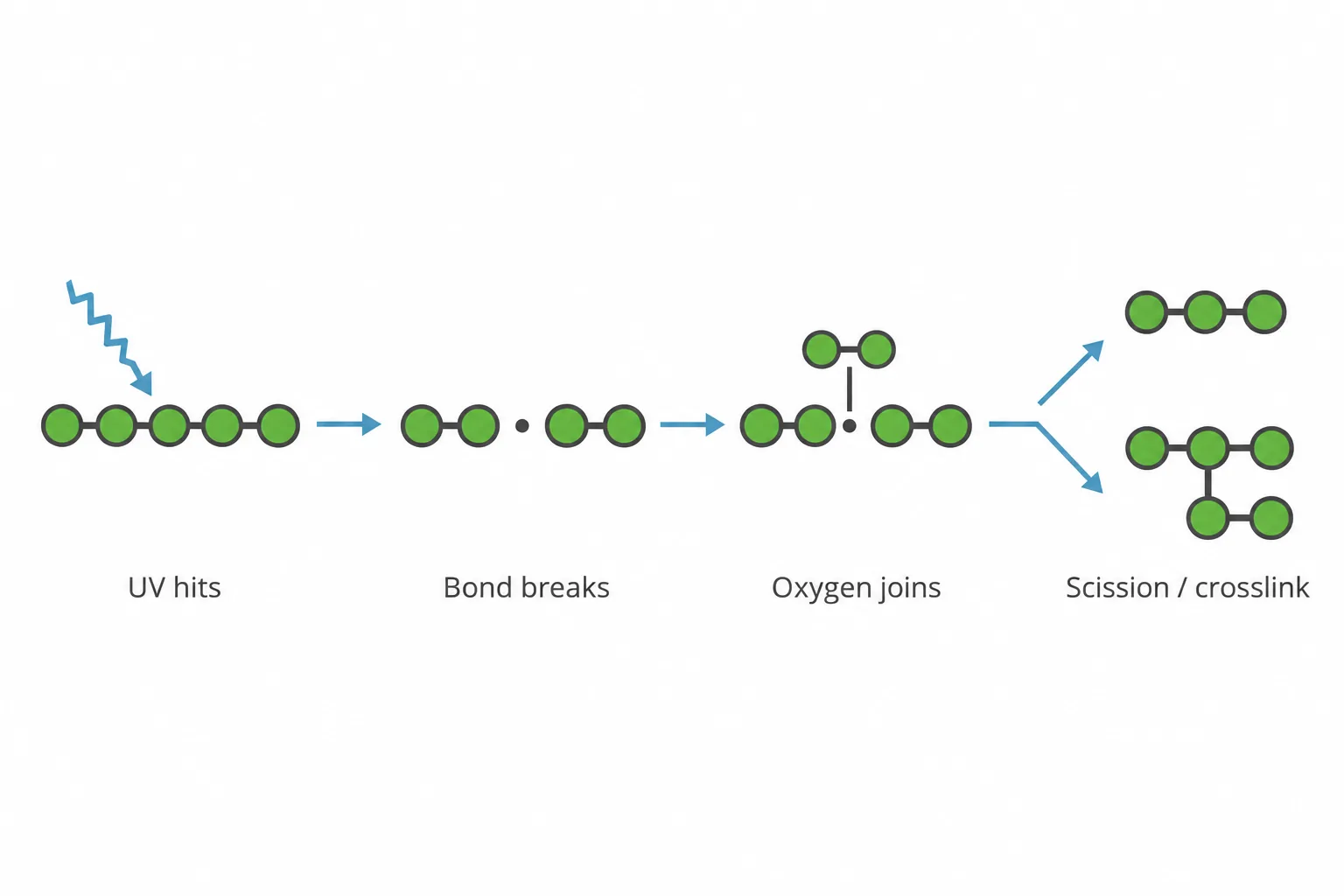
Ultraviolet photons carry enough energy to break bonds in an elastomer chain. Broken bonds create free radicals, radicals react with atmospheric oxygen, and photo-oxidation spreads through the surface layer. Chain scission softens the material. Extra crosslinking stiffens it. Most outdoor parts show both.
UV and ozone damage look alike from a distance but need different countermeasures, one reason rubber protection additive systems get specified as packages rather than single ingredients.
| Symptom | More likely cause | First countermeasure |
|---|---|---|
| Chalky surface, color fade | UV photo-oxidation | Screening filler plus UV absorber |
| Fine crazing across the exposed face | UV photo-oxidation | Stabilizer package review |
| Deep cracks perpendicular to strain | Ozone attack under stress | Antiozonant and wax bloom |
| Hardness rise with elongation loss | Oxidative crosslinking | Antioxidant level and cure state |
Strained surfaces crack first. A compound that lasts years as a static pad can fail in months as a flexed seal.
Polymer Base Sets the Ceiling on UV Performance
Backbone chemistry decides how much work the rest of the formula has to do. Saturated backbones give UV and ozone few double bonds to attack.
| Polymer | Backbone | Inherent UV resistance | Still needs |
|---|---|---|---|
| Silicone (VMQ) | Saturated | Excellent | Antioxidant for high heat |
| EPDM | Saturated | Excellent | Filler screening for long field life |
| Butyl (IIR) | Nearly saturated | Very good | Standard antioxidant package |
| HNBR | Partly saturated | Good | Carbon black loading |
| NBR | Unsaturated | Poor | Screening filler, antiozonant, or a move to HNBR |
| SBR, polybutadiene, natural rubber | Highly unsaturated | Poor | Full screening and stabilizer system |
Substitution projects carry the same burden. Programs built on eco friendly rubber alternatives clear the identical weathering bar, so a greener raw material list does not remove the stabilization work.
Additive Systems That Block or Absorb UV
| Additive class | Mechanism | Best fit | Limitation |
|---|---|---|---|
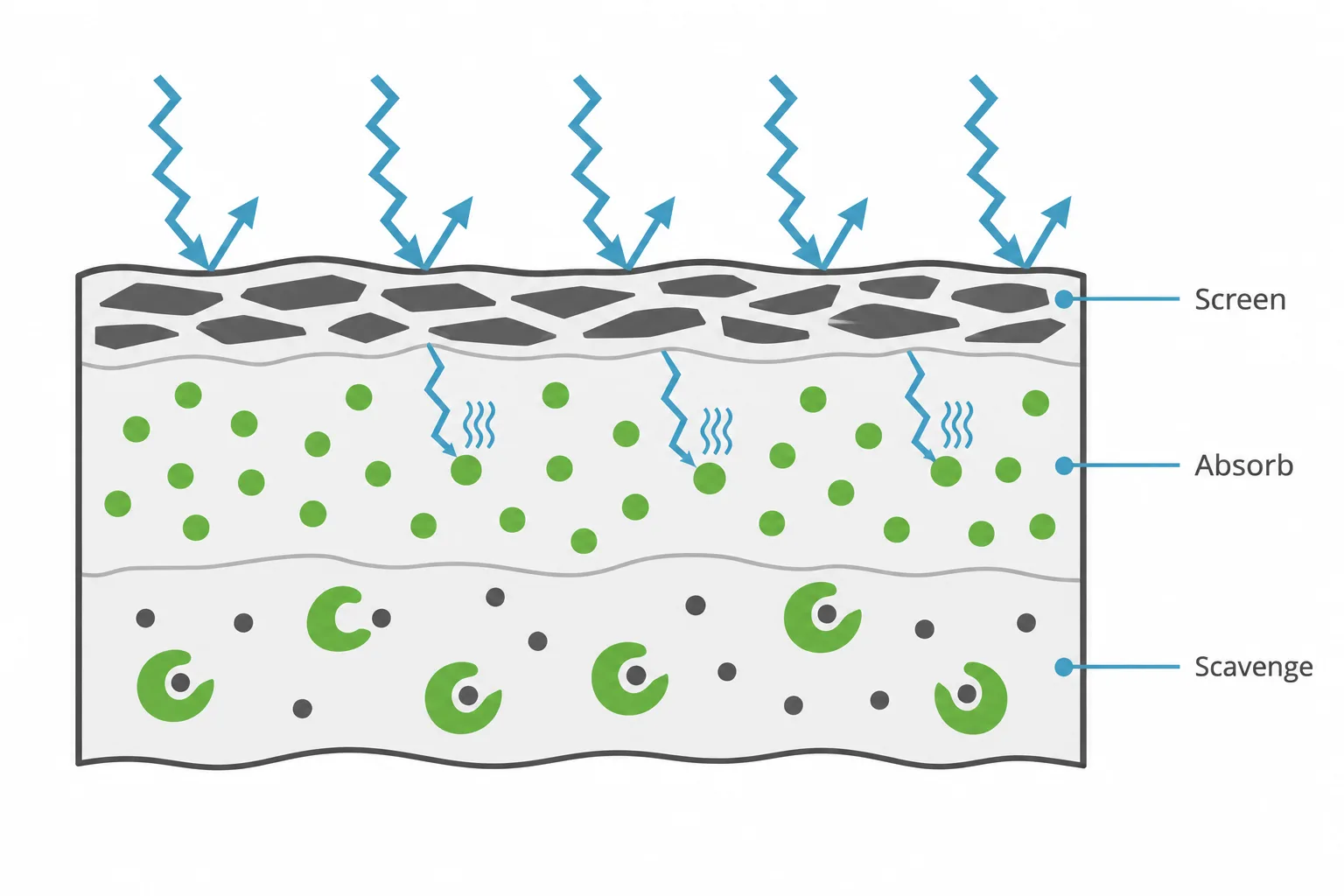
| Opaque screeners (carbon black, coal-derived filler) | Absorb radiation before it penetrates | Black compounds, any polymer | Color fixed at black or dark gray |
| Titanium dioxide | Scatters and reflects radiation | Light colored parts | Grade dependent outdoors |
| UV absorbers (benzotriazole, benzophenone) | Convert absorbed UV into low grade heat | Light and translucent compounds | Thin sections give a short path |
| Radical scavengers (HALS) | Trap radicals formed after initiation | Long service outdoor parts | Deactivated in acidic or halogenated systems |
| Antioxidants | Interrupt the oxidation chain | Every outdoor compound | Consumed over time; some stain |
Hindered amine light stabilizers work on a different principle from absorbers. They do not screen light at all. Instead they trap the free radicals produced during photo-oxidation, so a small loading keeps working over long exposure. Pair an absorber with a scavenger and you cover both incoming radiation and the damage that slips past.
Formulators who specify UV stabilizer additives for rubber meet the same building blocks again in polyurethane additives, adhesive additives, and other specialty additives sold into coatings and plastics.
Carbon Black and Coal-Based Fillers as UV Screens
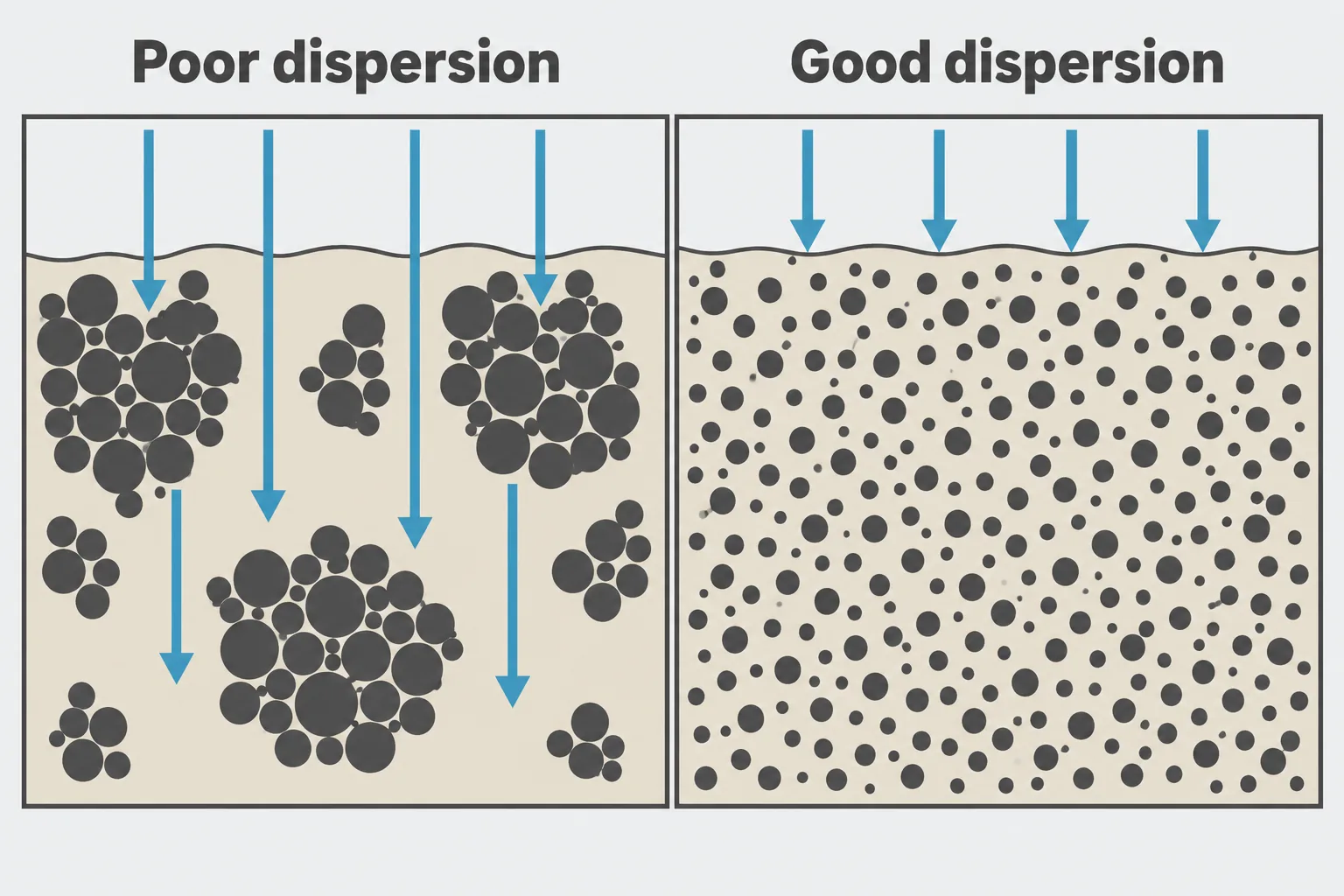
Carbon black stays the workhorse because it absorbs broadly across UV and visible light, sheds the energy as heat, and reinforces the compound at the same time.
Two variables outrank the headline loading figure. Particle size sets screening surface area per unit weight, and dispersion decides whether that screening is uniform. Agglomerates leave polymer-rich windows where radiation passes straight through.
Austin Black 325 is a finely divided powder made from low-volatile bituminous coal. It serves as a co-filler or partial replacement alongside carbon black for rubber where a dark, opaque, low specific gravity filler helps weather performance and part weight together.
For teams screening carbon black alternatives under cost or supply pressure, that keeps weathering performance intact instead of trading it away. Filler choice also drives mix time and energy demand, so a filler decision and rubber durability are one question, not two.
Process and Part Design Beyond the Formula
A correct stabilizer package underperforms when the mixing room misses details. Rate dispersion on cured samples, control the stabilizer addition stage so nothing is lost to heat or scorch, hold dump temperature down to protect antioxidant reserve, and balance bloom so waxes migrate while absorbers stay put.
Design levers need no reformulation: cut static strain on exposed faces, add section thickness in high exposure zones, let trim shade the critical surface. Store stock away from direct sun and clean with mild detergent rather than solvents that strip protective bloom. Compounds built around Austin Black 325 for weather resistance still benefit from those habits.
Test Methods That Prove UV Resistance Before Launch
| Method | Exposure | What it reports | What it will not tell you |
|---|---|---|---|
| ASTM G154, fluorescent UV lamp | Narrow UV band with condensation cycles | Surface crazing, gloss and color shift, property loss | Full-spectrum or heat driven behavior |
| ASTM G155, xenon-arc | Simulated full-spectrum sunlight with moisture | Combined UV, visible, and thermal response | Pollution and ozone effects |
| Ozone chamber | Controlled ozone at set strain | Crack onset under stress | UV-specific surface chemistry |
| Outdoor exposure racks | Real climate over long periods | Field-correlated performance | Fast answers inside a development cycle |
Treat accelerated data as a ranking tool for candidate formulas, not a service life calculator, since field results shift with geography, orientation, and microclimate.
As James Pickett, a polymer degradation specialist who spent his career at GE Research, explains:
> “Accelerated weathering test procedures of relatively short duration can at best only weed out very poorly performing materials intended for long duration applications such as solar energy.”
The same logic holds for rubber. A pass in G154 or G155 ranks your candidates, but it doesn’t clear a part for years outdoors.
Test Austin Black 325 in Your Compound
Choosing a filler is easier with a supplier that knows rubber. We’ve been making fillers in the U.S. since 1987, and today we supply customers in more than 30 countries through 11 distributors.
Our flagship, Austin Black 325, is a fine coal-based powder made for rubber makers who want lighter parts and easier processing. We produce it with low CO2 emissions. It also works as a co-filler or partial replacement for carbon black, so you can cut cost without a full reformulation.
You don’t have to guess how it will perform. Our technical team can run formula tests and send you a lab sample to compare with your current compound. We also offer toll grinding and custom packaging.
Need a sample? Contact us today.
Frequently asked questions
How do you protect rubber from UV?
How do you improve UV resistance of rubber compounds?
Which rubber materials resist UV best?
Is nitrile rubber UV resistant?
What blocks 100% of UV rays?
How to Improve UV Resistance of Rubber Compounds: Key Takeaways
| Lever | Action | Common mistake |
|---|---|---|
| Polymer | Match backbone saturation to exposure | Chasing additives to rescue the wrong base polymer |
| Screening filler | Use fine particle, well dispersed opaque filler | Judging loading by weight instead of dispersion |
| Stabilizers | Combine absorber, scavenger, and antioxidant | Single-additive packages |
| Process | Control mix stage and dump temperature | Stabilizer added too late or too hot |
| Validation | Rank candidates with G154 or G155 data | Reading test hours as field years |
Weathering work comes down to a trade between screening performance, weight, cost, and processability. If a low specific gravity screening filler fits that trade, review the Austin Black 325 product details and ask the CFI technical team for a lab sample to run against your current control compound.