
In rubber compounding, an insulating rubber filler is a particulate material blended into an uncured elastomer to influence electrical resistance, dielectric behavior, density, processing, mechanical properties, and cost. The right choice depends on the elastomer, filler grade, loading, dispersion, cure system, moisture exposure, and required test method.
This is different from a finished sealant or foam used to fill a physical gap. Those products may be relevant to installers, but this guide focuses on filler selection for manufacturers of rubber and silicone compounds.
Article Summary
| Question | Short answer |
|---|---|
| What is an insulating rubber filler? | A particulate material added to an uncured rubber compound to help meet electrical, mechanical, processing, weight, or cost requirements. |
| What should formulators compare? | Filler type, specific gravity, loading, dispersion, cure response, moisture behavior, and finished-compound performance. |
| Does carbon black help electrical insulation? | Some carbon black grades can form conductive networks at sufficient loading, so electrical performance must be tested in the finished compound. |
| Where may Austin Black 325 fit? | It is a low-specific-gravity, coal-derived filler that can be evaluated for volume, weight, processability, and cost objectives. |
| What should be tested before approval? | Material data, mixing behavior, cure, mechanical properties, electrical properties, environmental conditioning, and cost per finished volume. |
What Is an Insulating Rubber Filler in Rubber Compounding?
An insulating rubber filler is a dry, finely divided material incorporated into an uncured elastomer before the compound is shaped and cured. It is not the same as a sealant, potting compound, expanding foam, or preformed insulation product. In a rubber compound, the filler works with the polymer and the rest of the formulation; it does not provide a universal electrical or thermal rating by itself.
CFI Carbon Products has manufactured filler materials since 1987 and supplies manufacturers in rubber, plastics, silicone, and coatings. Austin Black 325 belongs to the dry-filler category. CFI’s rubber-industry materials describe how low specific gravity, processability, air retention, and compound economics can matter to rubber manufacturers.
| Material category | Typical role in a compound or product | What to evaluate | CFI relevance |
|---|---|---|---|
| Dry mineral or coal-derived filler | Adds volume and may affect density, processing, mechanical behavior, and cost. | Specific gravity, particle size, moisture, dispersion, loading, and compound testing. | Austin Black 325 is in this category. |
| Reinforcing carbon black | Supports strength, abrasion resistance, and other mechanical or processing objectives. | Grade, structure, surface area, loading, dispersion, and electrical effect. | Do not assume every carbon-based filler has the same behavior. |
| Conductive carbon filler | Creates a conductive or semiconductive path when the formulation reaches the required loading and network structure. | Resistivity, percolation behavior, frequency, temperature, and moisture. | Relevant when conductivity is required, but potentially unsuitable for an insulating compound. |
| Silica, clay, calcium carbonate, and other mineral fillers | May contribute stiffness, volume, processing, opacity, or cost control. | Grade-specific interaction with the polymer, cure system, moisture, and target properties. | Use an approved supplier specification and trial formula. |
| Finished sealants, foams, and insulation products | Fill or protect a physical space after manufacture. | Cure, adhesion, thermal performance, electrical rating, fire rating, and service conditions. | A different product category from a dry rubber-compounding filler. |
How Filler Choice Affects Electrical Insulation in Rubber
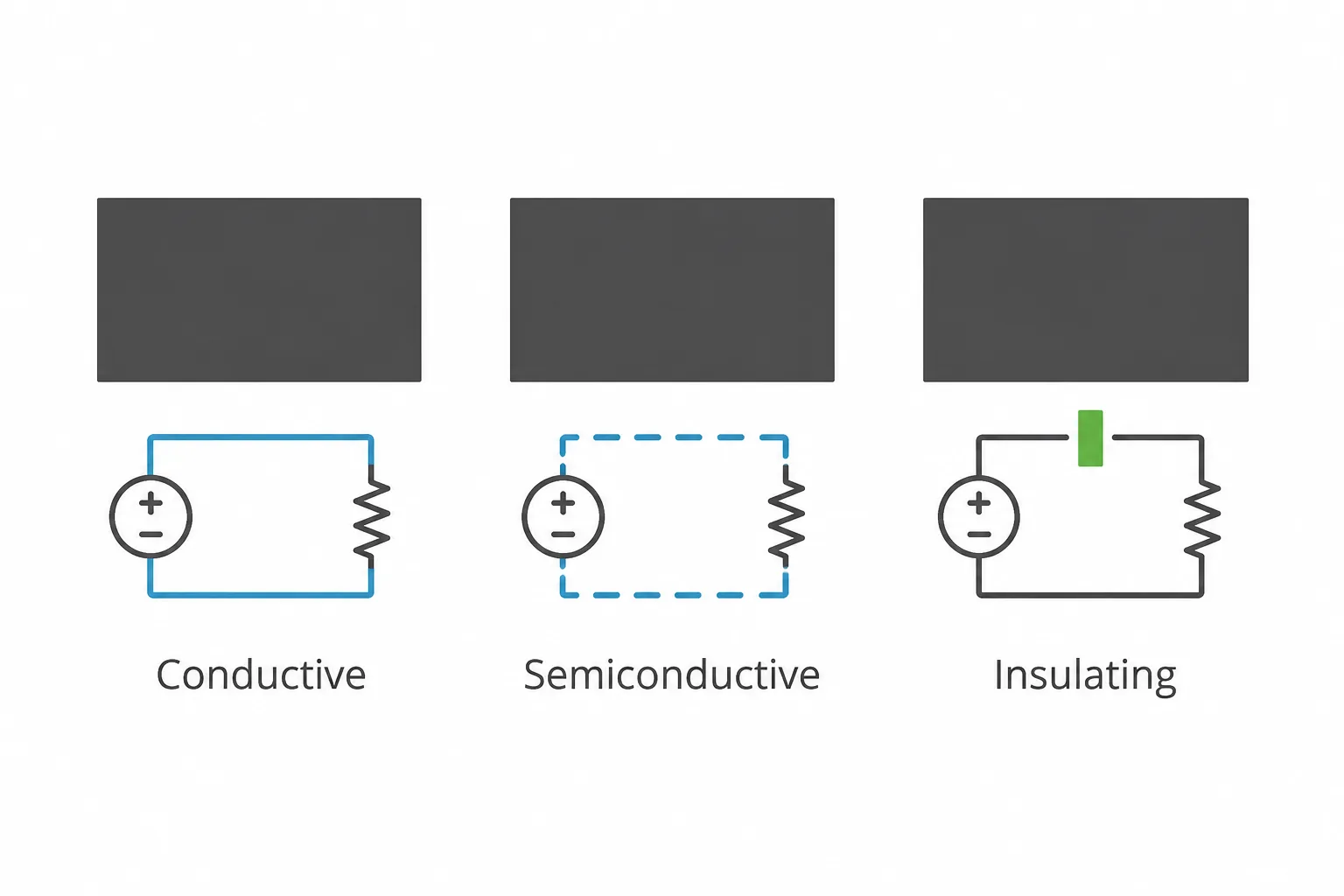
Rubber can serve as an electrical insulator, but the base polymer alone does not establish the final rating. Filler type, filler loading, dispersion, cure system, thickness, moisture, temperature, and frequency can all affect volume resistivity and dielectric behavior.
Thermal conductivity is a separate property. A formulation selected for electrical resistance should not be described as thermally insulating unless thermal performance has also been measured under the relevant conditions.
Color is not a performance specification: a black compound may be conductive, semiconductive, or electrically insulating depending on its materials and formulation.
CFI’s explanation of carbon conductivity provides useful background, but the finished compound remains the product that must be qualified.
Carbon Black and Electrical Conductivity in Rubber Compounds
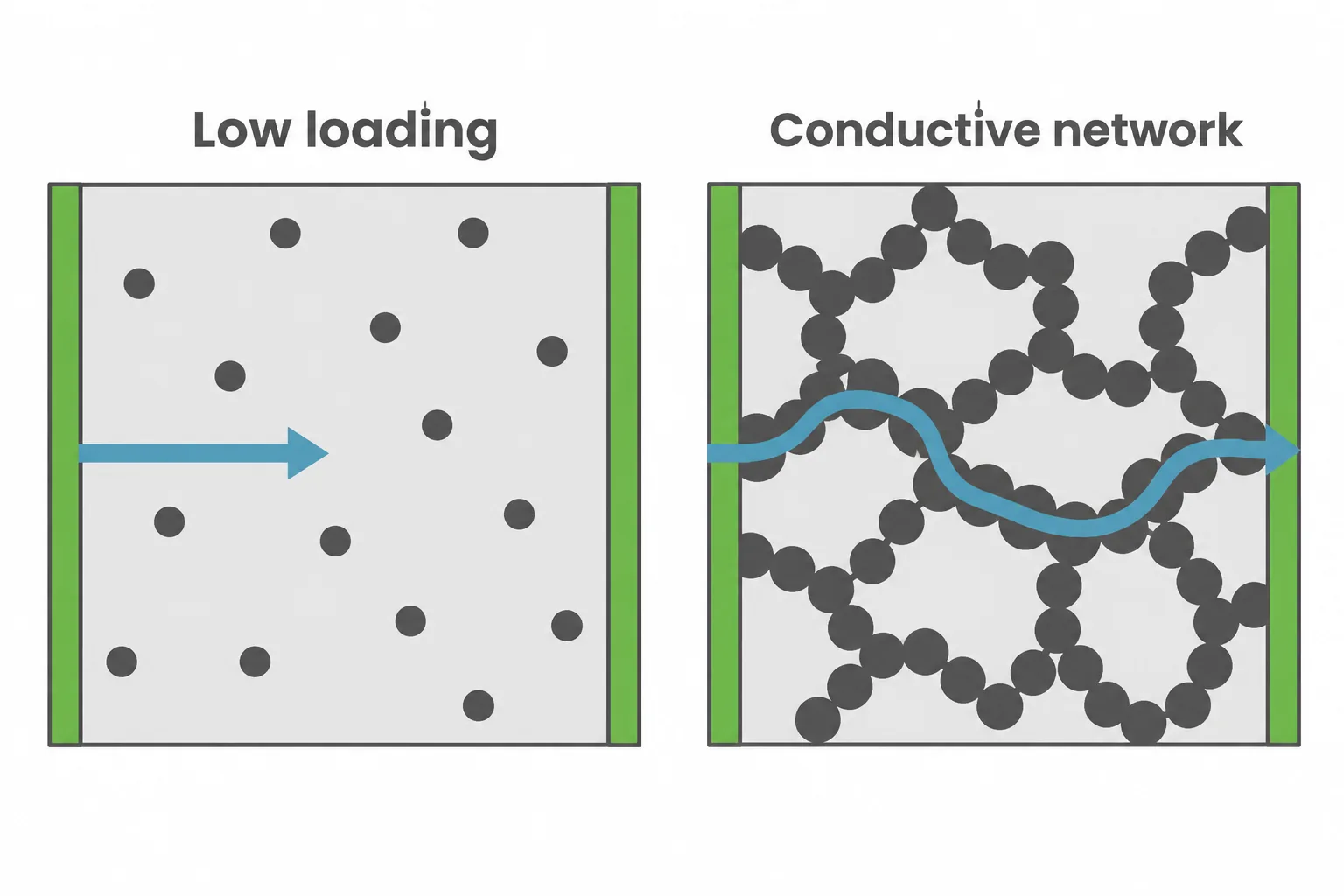
Carbon black is widely used in rubber compounding for reinforcement, abrasion resistance, UV protection, and processing benefits. Some grades can also create a conductive network at sufficient loading. In a Scientific Reports study of carbon-black/polymer composites, conductivity increased sharply after a matrix-specific percolation threshold. That mechanism is useful background, but the reported threshold should not be treated as a universal value for every rubber or silicone compound.
Austin Black 325 is not carbon black. CFI describes it as a dry, finely divided filler made from high-quality, low-volatile bituminous coal. Its low specific gravity may affect filler volume, finished-part weight, processability, and cost per unit of finished volume compared with denser materials. Whether it supports a required insulating property must be established in the target formulation rather than inferred from its color, origin, or density alone. Learn more about Austin Black 325 before selecting it for a trial.
| Filler | Origin or type | Electrical consideration | Reason a formulator may evaluate it |
|---|---|---|---|
| Conductive carbon black | Engineered carbon black with grades designed for conductivity | Conductivity can rise sharply when a connected network forms. | Antistatic, semiconductive, or other applications where controlled conductivity is required. |
| Reinforcing carbon black | Carbon black selected for mechanical reinforcement | Electrical behavior varies by grade, loading, dispersion, and polymer matrix. | Strength, abrasion resistance, durability, UV protection, and processing. |
| Austin Black 325 | Coal-derived, finely divided filler | Do not assign an electrical rating without testing the finished compound. | Lower specific gravity, processability, volume economics, and formulation evaluation. |
| Other mineral fillers | Grade-specific mined or manufactured materials | Electrical behavior depends on composition, moisture, surface treatment, and loading. | Stiffness, bulk, opacity, processing, cost, or other formulation objectives. |
Specific Gravity, Part Weight, and Cost per Volume
A price-per-pound comparison can miss the effect of density. A lower-specific-gravity filler occupies more volume per unit mass, which may change the amount of material required for a given part volume and may reduce finished-part weight. The result is not automatic savings: compare material price, loading, dispersion, production rate, scrap, and finished-part volume in the actual formula.
CFI’s profitability information illustrates the volume difference between equal masses of fillers and explains why formulators should consider cost per finished volume rather than price per pound alone. Treat the calculation as a formulation comparison, not as a guaranteed result for every compound.
How to Qualify an Insulating Rubber Filler Before Production
A controlled trial should compare a current compound with a trial compound while keeping the polymer, cure system, processing conditions, and target loading basis as consistent as practical. The test plan should reflect the final product specification rather than relying on a filler’s appearance or a single material property.
| Evaluation area | What to compare | Why it matters |
|---|---|---|
| Material data | Specific gravity, particle size, moisture, composition, handling information, and lot consistency. | These properties affect loading, dispersion, safety, and repeatability. |
| Processing | Mixing time, dispersion, viscosity or flow behavior, air release, and cure response. | A filler that is difficult to process may reduce the value of an otherwise attractive material. |
| Mechanical properties | Hardness, tensile strength, elongation, compression set, abrasion, and durability where relevant. | Electrical insulation cannot be evaluated separately from the part’s service requirements. |
| Electrical properties | Volume resistivity, dielectric strength, dissipation factor, and the effect of relevant temperature, frequency, and moisture conditions. | The finished compound, not the filler name, must meet the customer’s electrical requirements. |
| Environmental performance | Moisture conditioning, thermal aging, chemical exposure, and service-temperature effects where applicable. | Electrical and mechanical properties may change during use. |
| Economics | Filler mass, compound density, cost per finished volume, production rate, and scrap. | This connects material selection with actual manufacturing economics. |
Before a trial, review CFI’s current Austin Black 325 technical data sheet and safety data sheet. The SDS identifies Austin Black 325 as a processed mineral filler derived from low-volatile bituminous coal and recommends it for filler and pigment use in rubber, plastic, and industrial applications. Follow the documented dust-handling and site-safety controls during evaluation.
CFI Services for Filler Evaluation
CFI supports manufacturers through formula testing, lab samples, packaging options, toll grinding for black minerals, and global collaboration. These services can help a formulator investigate a material in a controlled process, but the customer’s finished product still requires its own qualification and approval. Review CFI’s technical services when planning a sample or formulation discussion.
CFI also serves silicone manufacturers; its silicone-industry information discusses customer-reported compression, insulating, and cost-related results. If emissions are part of the purchasing specification, review CFI’s sustainability information and request the supporting documentation relevant to the product and application.
Key Takeaways
| Takeaway | Why it matters |
|---|---|
| Define the product category first. | A dry compounding filler is not the same as a finished sealant, foam, or insulation product. |
| Treat electrical performance as compound-specific. | The polymer, filler, loading, dispersion, cure, moisture, thickness, temperature, and frequency all matter. |
| Do not judge conductivity by color. | Carbon-based materials can have different electrical behavior at different grades and loadings. |
| Compare density by finished volume. | Specific gravity can affect part weight and material economics, but the actual formula must be tested. |
| Use a controlled trial before approval. | Processing, mechanical, electrical, environmental, and cost results should be reviewed together. |
Frequently asked questions
What is an insulating rubber filler?
Does carbon black make rubber conductive?
Is Austin Black 325 an insulating filler?
Is Austin Black 325 the same as carbon black?
How does specific gravity affect rubber filler cost?
What should be tested before approving an insulating rubber filler?
Request an Austin Black 325 Sample or Formula Review
If you are evaluating Austin Black 325 for a rubber or silicone compound, request a sample with your target properties, formulation details, processing conditions, and required testing information. CFI can discuss available formula-testing support and the next steps for a controlled trial.