
Article Summary
Fillers can influence processing, part weight, and rubber properties, but their effects depend on the grade, loading, polymer, cure system, and molding process. This guide compares mineral fillers for molded rubber goods, explains what to verify when evaluating grades for molded parts, and shows where CFI’s Austin Black 325 fits as a separate coal-based filler candidate.
| Filler family | Potential role | What to validate in the compound |
|---|---|---|
| Calcium carbonate | Often used as an extender; some grades can contribute to reinforcement | Grade, surface treatment, loading, dispersion, and effect on required mechanical properties |
| Kaolin clay | Selected grades can provide semi-reinforcement | Grade type, treatment, cure response, and performance against the part specification |
| Precipitated silica | Reinforcing option for some rubber formulations, including light-colored compounds | Dispersion, coupling approach where needed, cure response, and target properties |
| Talc | A platy mineral considered for selected processing or barrier targets | Grade, loading, orientation, and measured permeability or surface performance |
| Barite (barium sulfate) | A high-density filler when added mass is required | Specific gravity, effect on compound properties, and application-specific performance |
What Mineral Fillers Do in a Molded Rubber Compound
Filler grade and loading can influence the mechanical behavior, uncured processability, cure response, density, color, and cost of a rubber compound. The result depends on particle size and distribution, surface area and chemistry, particle shape, treatment, dispersion, polymer, cure package, and the molding process. A filler’s name alone does not predict finished-part performance.
For molded goods, compare candidate compounds against the part’s requirements: for example, tensile and tear strength, hardness, compression set, abrasion, permeability, dimensional stability, surface quality, and process consistency. Select only the tests that apply to the product and its service conditions.
Reinforcement, Semi-Reinforcement, and Extension
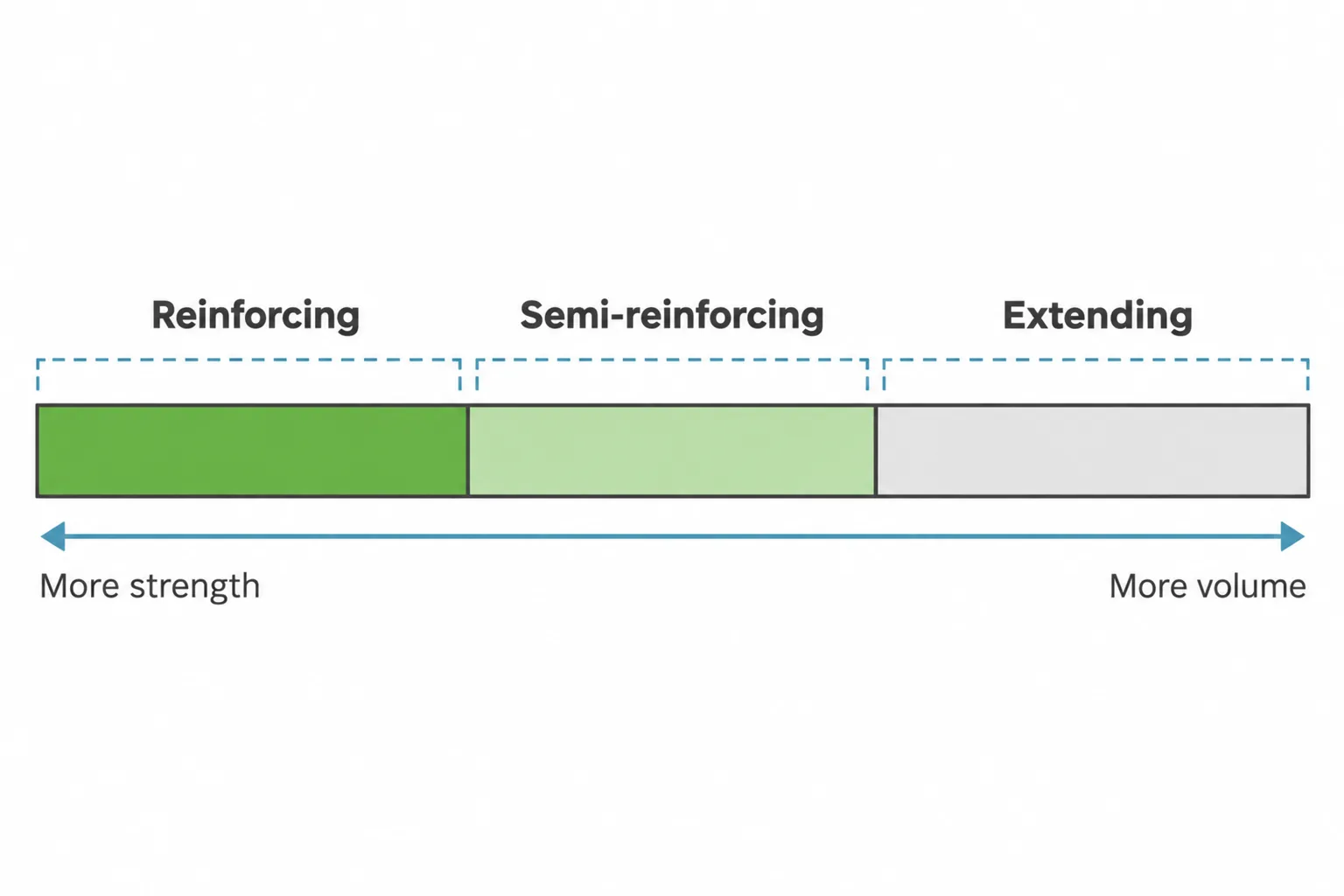
Compounders often group fillers by their effect in a particular rubber formulation: reinforcing, semi-reinforcing, or extending. These categories are useful for screening, but a grade may behave differently depending on its properties and the rest of the recipe. A technical overview of non-black fillers used in rubber describes calcium carbonate, kaolin clay, and precipitated silica among the principal non-black filler families, with other minerals used for specific purposes.
| Filler class | Examples to evaluate | Potential contribution | Qualification point |
|---|---|---|---|
| Reinforcing | Carbon black; precipitated silica in suitable formulations | May contribute to strength, modulus, tear, or abrasion properties | Confirm the grade, loading, polymer, cure system, and dispersion |
| Semi-reinforcing | Selected hard kaolin and fine calcium carbonate grades | May affect modulus, hardness, or other compound properties | Compare data for the specific grade and compound |
| Extending or functional | Selected calcium carbonate, talc, or barite grades | May add volume or serve a targeted functional purpose | Check density, processing, and mechanical-property changes |
Five Mineral Filler Types to Compare for Molded Rubber Goods
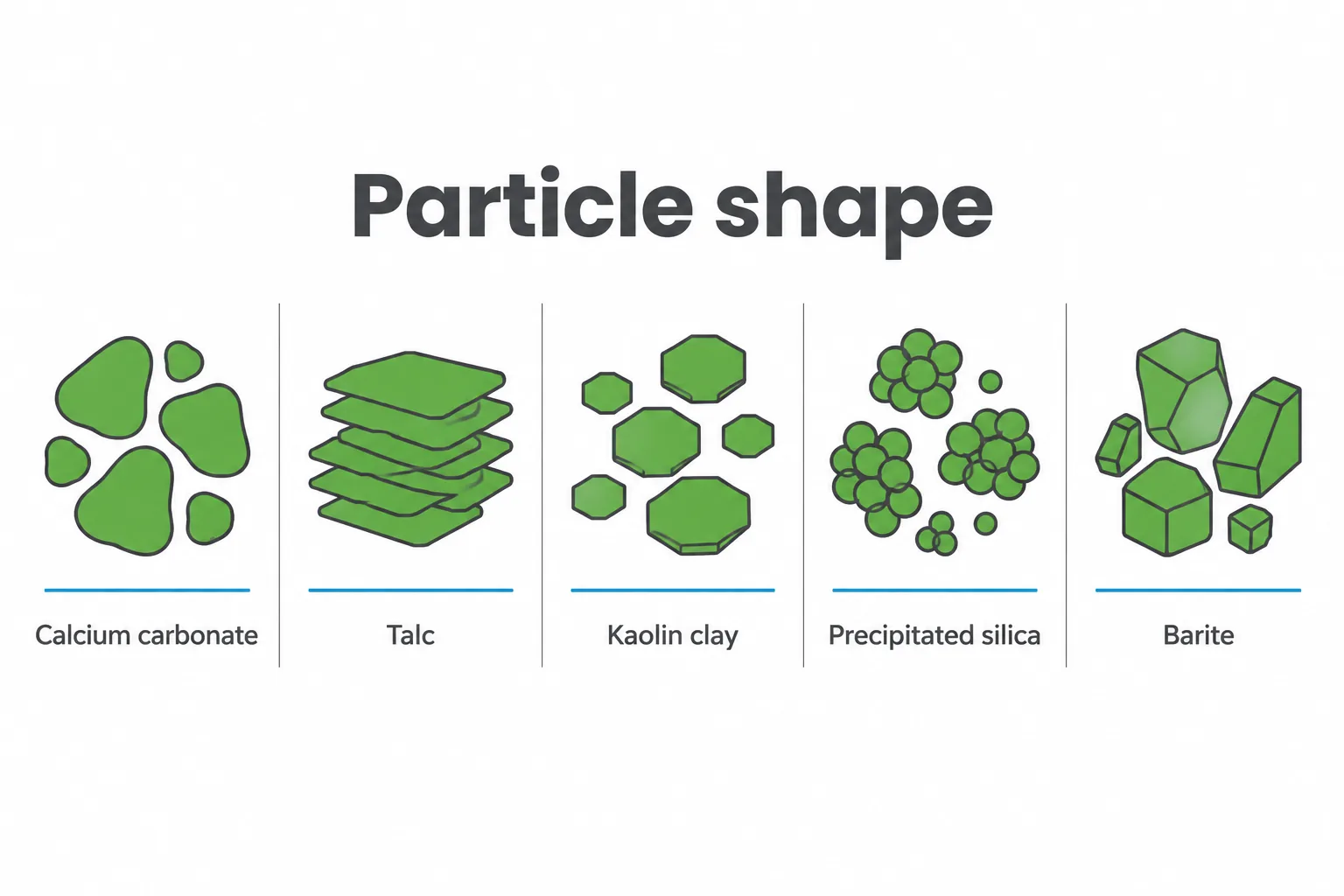
The five materials below are candidates to compare, not a ranking of the most-used fillers or a formulation recommendation. Specific gravity and functional performance vary by grade; use the supplier’s current technical data for the product you are evaluating.
| Mineral | General role to investigate | Potential molded-rubber context | What to check |
|---|---|---|---|
| Calcium carbonate (whiting) | Extender; selected fine or treated grades may offer additional functionality | General molded goods and compounds where loading economics matter | Ground or precipitated type, particle size, treatment, dispersion, and property changes |
| Talc | Platy mineral filler | Selected compounds where surface or barrier properties are relevant | Particle shape and size, loading, dispersion, and measured permeability |
| Kaolin clay | Extender or semi-reinforcing filler, depending on grade | Selected molded, footwear, or cable compounds | Hard or soft grade, treatment, moisture, cure response, and electrical requirements |
| Precipitated silica | Reinforcing filler in suitable formulations | Light-colored rubber goods and other applications with defined reinforcement needs | Surface properties, dispersion, coupling system, cure, and target properties |
| Barite (barium sulfate) | High-density functional filler | Parts where added mass or a specifically tested damping property is desired | Density, loading, processability, and results in the finished part |
Calcium Carbonate (Whiting)
Ground and precipitated calcium carbonate differ in particle size and surface characteristics. Coated or treated grades may process differently from untreated grades, so evaluate the exact product rather than assuming that one type will reduce viscosity or improve mold filling. Test dispersion, flow, cure, and mechanical properties at the proposed loading.
Talc
Talc has a platy particle shape. Some grades may be considered when a formulation has a defined barrier or surface target, but the effect depends on particle characteristics, loading, orientation, and dispersion. Measure the relevant property in the complete rubber compound; do not infer lower gas or moisture transmission from the mineral name alone.
Kaolin Clay
Rubber-grade kaolin includes hard and soft clay grades with different particle and reinforcing characteristics. A china clay reference entry provides background on the material and its classifications; for rubber use, rely on the grade’s technical data and compound trials. Calcined or surface-treated grades may behave differently from untreated grades. Check cure response and electrical properties against the intended specification instead of assuming all kaolin grades are suitable for cable compounds.
Precipitated Silica
Precipitated silica can reinforce some rubber compounds, including light-colored formulations. In many systems, a coupling agent is used to improve interaction between silica and the rubber, but the appropriate approach depends on the polymer, silica grade, and process. Evaluate mixing, dispersion, cure behavior, and the properties required for the molded part.
Barite (Barium Sulfate)
Barite is a high-density mineral filler that may be considered when added mass is part of the design. Claims about sound damping or radiation shielding require application-specific evidence and testing; they should not be assumed from barite content alone. Its density can also increase finished-part weight, which may conflict with lightweighting goals.
Filler Choice and Molded Part Weight
Specific gravity helps estimate the solid volume contributed by a filler at a given mass. A lower-specific-gravity filler occupies more solid volume per unit mass than a denser filler, but that fact alone does not establish lower cost per part, higher part yield, or equivalent performance.
Related readingSemi-Reinforcing Fillers for Rubber: Types & LimitsRead the guide →| Comparison | What specific gravity can indicate | What it cannot establish by itself |
|---|---|---|
| Two filler grades at equal mass | Their relative solid-volume contribution | The density or performance of the complete compound |
| A proposed filler replacement | A reason to compare compound density and part weight | Whether the formulation meets its mechanical, cure, or service requirements |
| Cost per molded part | One input to the calculation | Savings without grade pricing, loading, compound density, scrap, and processing data |
Compare candidates at the same part specification. Calculate compound cost and density from the full formula, then validate part weight and performance in a trial. CFI reports Austin Black 325’s specific gravity and rubber-industry applications. Use the current product data sheet and a formulation-specific test before concluding a part.
When to Consider Non-Black Fillers
Non-black fillers may be considered when a product has color, cost, processing, or performance requirements that support evaluating them. They do not automatically replace reinforcing carbon black, and a partial replacement can change the compound’s properties. Treat each substitution as a formulation change and qualify it against the required part specification.
Austin Black 325 is a coal-derived filler, distinct from conventional furnace carbon black and from the mineral grades discussed above. CFI’s profitability information links to an independent evaluation of Austin Black 325 in specific elastomer formulations. The study’s results apply to the tested recipes and conditions; they do not establish a universal replacement ratio or outcome. Read the ACE Laboratories evaluation.
Grade Selection for a Specific Part
Start with the property or production issue you need to address. Use the table to identify candidates for evaluation, then confirm the result in your formulation.
| Target | Candidate to evaluate | What to verify |
|---|---|---|
| Compound cost | Calcium carbonate or another grade that meets the specification | Cost at the proposed loading, compound density, and required mechanical properties |
| Tear or tensile performance | A reinforcing filler suited to the polymer and cure system | Measured properties, dispersion, and processability |
| Permeability | A suitable platy filler may be considered | Gas or moisture transmission in the complete compound |
| Modulus or hardness | Selected kaolin or calcium carbonate grades | Cure response and all required mechanical properties |
| Added mass | Barite or another high-density candidate | Part weight, processing, and the specified functional result |
| Lower part weight | A candidate with lower specific gravity | Full-compound density, loading, and whether performance remains acceptable |
Before a trial, collect the grade’s technical data, safety information, particle-size distribution, specific gravity, moisture, surface treatment, and other properties relevant to the formulation. Set a control recipe and acceptance criteria, then use a loading ladder and change one variable at a time where practical. ASTM D7723-24 describes a method for measuring macro-dispersion of fillers in rubber compounds; use it when it fits the trial plan and specification.
CFI describes product samples, formula testing, packaging options, and toll grinding services. Confirm with CFI which support applies to an Austin Black 325 evaluation; these services do not mean CFI supplies every mineral listed in this guide.
Mineral Filler Supply: What Buyers Should Verify
The word “supply” involves more than finding a mineral name on a product list. Before approving a source, ask the supplier whether it can provide:
- A current technical data sheet and safety data sheet for the exact grade.
- Lot-specific certificate of analysis, if available, and the limits used to accept each batch.
- Particle-size distribution, specific gravity, moisture, surface treatment, and other grade data relevant to your compound.
- Available packaging, storage and handling guidance, sample availability, lead-time information, and a process for communicating specification changes.
- Technical support for a controlled trial and a clear record of the formulation and test conditions.
CFI’s published product and service information centers on Austin Black 325 and CFI’s testing, sampling, packaging, and toll-grinding support. If you need a source for calcium carbonate, kaolin, silica, talc, or barite, verify availability directly with a supplier that offers that specific mineral grade.
Questions Buyers Ask
Which mineral fillers are commonly used in rubber compounds?
Which filler is best for molded rubber goods?
How does specific gravity affect molded-part weight?
How can I check filler dispersion?
Is Austin Black 325 the same as carbon black?
Key Takeaways
| Point | What it means for your compound |
|---|---|
| Filler behavior is grade- and formula-specific | Use supplier data and test the complete compound |
| Specific gravity is one input to weight and cost comparisons | Calculate from the full formula and the required part specification |
| Mineral fillers and Austin Black 325 are distinct material choices | Do not assume a one-for-one replacement or guaranteed result |
| Supply qualification includes grade consistency and documentation | Check the exact product, lot data, packaging, and technical support |
Talk Through an Austin Black 325 Evaluation With CFI
If you are comparing Austin Black 325 with a mineral filler for a molded-rubber application, share the target properties and test conditions with CFI. Ask what product samples and formula-testing support are available for your application. Contact CFI.